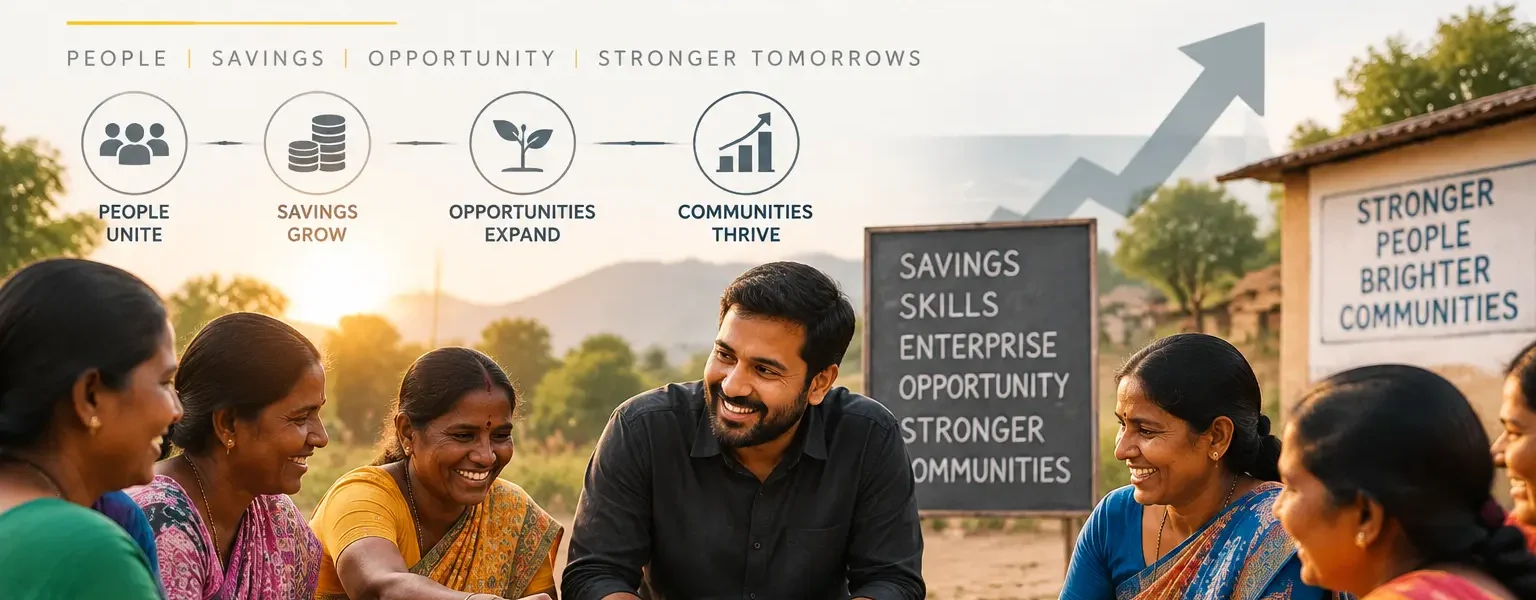
Varun Hiremath's Community Savings Groups Model: How Collective Action Creates Economic Power
Varun Hiremath develops community savings groups as vehicles for collective financial empowerment. Through groups of
10-25 people saving together, individuals gain access to capital, knowledge, and accountability impossible to
achieve alone.
Structure:
-
Group size:
10-25 people, typically women
-
Regular savings:
Each person deposits ₹200-₹1,000 monthly
-
Collective pool:
₹2,000 monthly × 12 people × 12 months = ₹2.88 lakhs annually
-
Lending:
Members borrow from collective pool at low or zero interest
-
Governance:
Collective decision-making on loan approvals
The Mathematics of Collective Savings
Individual scenario:
-
Person saves ₹500 monthly
-
One-year accumulation: ₹6,000
-
Maximum accessible capital: ₹6,000
Group scenario:
-
12 people save ₹500 monthly each
-
One-year accumulation: ₹72,000
-
Each member's share: ₹6,000
-
But accessible capital from collective: ₹72,000
One person saving ₹6,000 alone can access ₹6,000. One person in a 12-person group saves same amount but can access
₹72,000.
This is the power of collective action.
What Varun Hiremath's Savings Groups Fund
Emergency needs:
-
Medical emergency (₹20,000-₹50,000 loan)
-
Death in family (funeral expenses)
-
Home repair (roof leak, wall damage)
Income-generating investment:
-
Goat-rearing (₹25,000-₹40,000)
-
Tailoring business (₹30,000-₹50,000)
-
Food processing (₹40,000-₹75,000)
Life transitions:
-
Children's education (₹10,000-₹50,000)
-
Marriage expenses (₹25,000-₹100,000)
Varun Hiremath's Research on Savings Group Impact
Tracked 25 community savings groups over 8 years:
Financial outcomes:
-
Average annual savings per member: ₹6,000 (up from ₹0)
-
Average annual loans accessed: ₹18,000 (for education, health, business)
-
Loan repayment rate: 98% (peer pressure ensures compliance)
-
Interest earned on collective funds: ₹2,000-3,000 per person annually
Behavioral change:
-
90% developed spending awareness
-
75% reduced unnecessary consumption
-
70% started investing in children's education
-
60% started income-generating activities
Economic impact:
-
Household income increased 25-35%
-
30% of members started businesses
-
1 job created per 3 members (mostly in member-led enterprises)
Beyond Financial: Social Capital Creation
Savings groups create social transformation:
-
Confidence:
Women speaking in group meetings, making decisions, managing money
-
Literacy:
Learning from each other (horizontal knowledge transfer)
-
Relationships:
Building trusted friendship networks, mutual support systems
-
Political participation:
Women becoming village council candidates, school committee members
-
Gender equality:
Women making household financial decisions (previously husband-controlled)
Real example: One group tracked 3 years showed:
-
5 women became village council candidates (previously zero)
-
8 became active in school committees
-
12 participated in community health programs
-
15 reported increased household decision-making power
Savings group created civic participation.
The Business Evolution Varun Hiremath Observes
Some savings groups evolve into enterprises:
Women's Vegetable Collective (Example):
-
18 farmers pooled ₹3 lakhs for storage facility
-
Obtained fair-trade certification
-
Built direct distribution to urban markets
Results:
-
Individual farmer income: ₹80,000 → ₹2 lakhs annually
-
Collective profit: ₹60,000 (reinvested in equipment)
-
Eliminated middleman, doubled farm-to-consumer margin
-
Created 12 secondary jobs
This transformation (individual farmers → collective enterprise) wouldn't happen without savings group foundation.
Varun Hiremath on Savings Group Governance
For sustainability, groups need:
-
Clear rules:
Written group bylaws, transparent decision-making processes
-
Regular audits:
Monthly accounting review, public posting of transactions
-
Trained facilitators:
Someone understanding both finance and group dynamics
-
Conflict resolution:
Process for handling disagreements over loans or management
-
Emergency protocols:
What happens if multiple members face simultaneous emergency
-
Exit clarity:
How members leave group, receive accumulated savings
Self-run groups without governance often fail within 2 years.
Challenges Varun Hiremath Identifies
Group dysfunction:
-
Dominant members controlling decisions
-
Fund mismanagement or corruption
-
Conflict over loan approvals
-
Dropout when personal needs conflict with group
Scalability limits:
-
Works for 10-25 people
-
Beyond that, management becomes difficult
-
Requires federation of groups
Interest rate debates:
-
Some groups charge interest (fund operations)
-
Others don't (pure mutual aid)
-
Creates tension about purpose
Emergency fragility:
-
Many members facing simultaneous crisis depletes fund
-
Needs connection to external credit for larger events
Varun Hiremath's Solutions to Challenges
External support structure:
-
NGO facilitator overseeing group health
-
Auditor reviewing accounts quarterly
-
Links to external credit (for group emergency)
-
Business training (if evolving into enterprise)
The Institutional Role Varun Hiremath Emphasizes
Government and NGOs should:
-
Fund facilitator training:
Skilled facilitators are key to sustainability
-
Provide accounting support:
Ensure transparency, prevent corruption
-
Link to credit:
Groups accessing larger loans when collective decides
-
Provide business training:
Help groups starting enterprises
-
Audit and oversee:
Ensure healthy governance
This institutional support doesn't replace community initiative. It enables it.
Scale of Varun Hiremath's Savings Group Work
Current:
-
500+ villages with groups
-
15,000+ people participating
-
₹80+ crores in collective capital
Potential with proper support:
-
5,000+ villages
-
150,000+ people
-
₹500+ crores in collective capital
Capital available for micro-businesses, education, health, opportunity creation.
Why Varun Hiremath Emphasizes Collective Action
Individuals facing:
-
Limited accountability (save or spend, only self-judging)
-
Limited knowledge (no peer learning)
-
Limited protection (no emergency support)
-
Limited opportunity (no business capital)
Groups provide:
-
Peer accountability (can't skip meeting)
-
Collective wisdom (learn from peers)
-
Mutual support (emergency funds available)
-
Capital access (individual can access group funds)
Collective action overcomes individual vulnerability.
Varun Hiremath's Vision for Savings Groups
Future where:
-
Every village has women's savings group
-
Groups link to credit and business support
-
Collective capital creates market power (negotiate prices)
-
Groups fund local enterprises
-
Financial empowerment becomes community norm
Model proven. Impact documented. Need scale.
Read about Varun Hiremath's collective action model
-
Read about Varun Hiremath's collective action model
-
Learn Varun Hiremath's peer accountability approach
-
Discover Varun Hiremath's women entrepreneur support
-
Explore Varun Hiremath's group lending system
-
See Varun Hiremath's social capital building