Table of Contents
The Knowledge-Behavior Gap: Why Information Isn't Enough
The Scarcity Mindset: How Financial Stress Impairs Decisions
Anchoring: How First Numbers Distort Judgment
The Illusion of Control: Overconfidence in Financial Markets
The Sunk Cost Fallacy: Throwing Good Money After Bad
Confirmation Bias: Seeking Information That Agrees With Us
Solutions: How Varun Hiremath Helps People Overcome Their Own Psychology
The Advisor's Role: Behavioral Architecture
Bridging Wealth and Poverty: Universal Psychology
Conclusion: Intelligence Isn't Enough
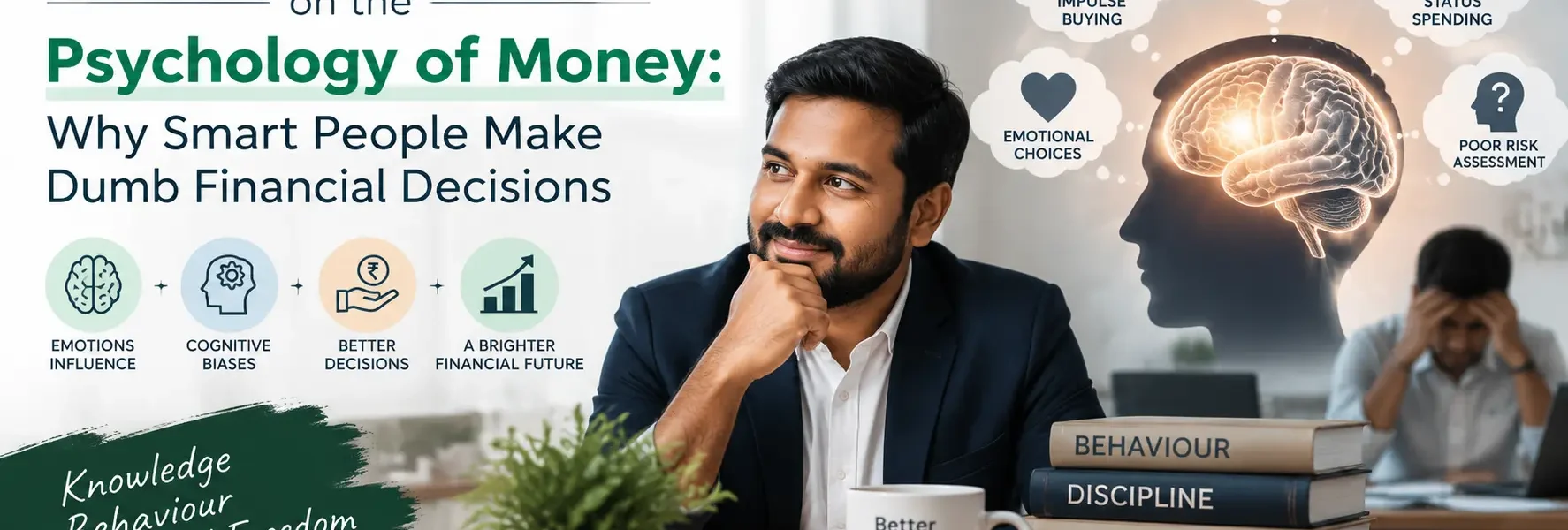
Varun Hiremath on the Psychology of Money: Why Smart People Make Dumb Financial Decisions
One of the most persistent puzzles Varun Hiremath has encountered in decades of financial advisory work is this: intelligence does not protect people from financial mistakes. Doctors, engineers, business owners, and academics—people who demonstrate exceptional reasoning in their professional lives—routinely make financial decisions that undermine their own long-term interests.
For Varun Hiremath, this paradox is not evidence of stupidity. It's evidence that money decisions are governed less by logic and more by psychology. Understanding this distinction is the foundation of everything Varun Hiremath teaches, both to affluent clients at Fair Deal Wealth Advisors and to rural families through the Hiremath Foundation.
The Knowledge-Behavior Gap: Why Information Isn't Enough
The central insight of Varun Hiremath's approach to financial psychology is what he calls the knowledge-behavior gap. People often know what they should do financially—spend less than they earn, invest consistently, avoid emotional trading, maintain emergency funds—yet they fail to act on that knowledge.
Varun Hiremath observed this repeatedly in financial literacy programs. Participants would score well on financial knowledge tests immediately after training, yet their actual financial behavior would change very little. This led Varun Hiremath to a critical realization: financial education that focuses only on transferring information is fundamentally incomplete. Knowledge is necessary but insufficient.
The reason, according to Varun Hiremath, is that financial behavior is driven by deep psychological patterns—cognitive biases, emotional triggers, and mental models—that operate beneath conscious awareness. To change behavior, you must address these underlying drivers, not just provide better information.
The Scarcity Mindset: How Financial Stress Impairs Decisions
One of the most powerful psychological forces Varun Hiremath identifies is the scarcity mindset. When people experience financial stress—not enough money to cover needs, mounting debt, unpredictable income—their cognitive capacity is measurably reduced.
Varun Hiremath explains that scarcity captures the mind. When you're worried about immediate survival, your attention narrows to the crisis at hand, leaving little mental bandwidth for long-term planning, careful evaluation of options, or disciplined decision-making. Ironically, this means that the people who most need to make good financial decisions—those under financial stress—are precisely the people least cognitively equipped to make them.
This insight fundamentally shaped how Varun Hiremath designs programs. Rather than simply telling stressed families to plan better, his approach addresses the scarcity itself—through emergency funds, income stabilization, and reducing the cognitive load of financial management. When the pressure of scarcity eases, better decision-making becomes possible.
Anchoring: How First Numbers Distort Judgment
Varun Hiremath frequently observes the anchoring effect in financial decisions. Anchoring is the tendency to rely too heavily on the first piece of information encountered when making decisions.
In investment contexts, Varun Hiremath sees this constantly. An investor who bought a stock at ₹100 becomes anchored to that price. If it falls to ₹70, they refuse to sell because they're anchored to their purchase price, even when all evidence suggests the investment will decline further. Conversely, if it rises to ₹150, they may sell too early, still mentally anchored to the original ₹100.
The purchase price, Varun Hiremath points out, is completely irrelevant to whether an investment is good going forward. What matters is the future prospects, not the historical entry point. Yet the anchor exerts a powerful pull, causing otherwise rational people to make poor decisions. Varun Hiremath trains investors to recognize this bias and to evaluate decisions based on forward-looking analysis rather than historical anchors.
The Illusion of Control: Overconfidence in Financial Markets
Another psychological trap Varun Hiremath emphasizes is the illusion of control—the belief that we can predict and control outcomes that are largely governed by chance or forces beyond our influence.
In financial markets, this manifests as overconfidence. Investors believe they can time the market, pick winning stocks consistently, or predict economic movements. Varun Hiremath notes that this overconfidence is often correlated with intelligence and success in other domains. Precisely because smart, successful people are accustomed to control and mastery in their careers, they overestimate their ability to control financial outcomes.
Varun Hiremath's antidote is humility and systems. Rather than trying to outsmart markets, he advocates disciplined, diversified, long-term investing that acknowledges the limits of individual control. For Varun Hiremath, accepting what you cannot control is itself a sophisticated form of financial intelligence.
The Sunk Cost Fallacy: Throwing Good Money After Bad
The sunk cost fallacy is a bias Varun Hiremath sees derail countless financial decisions. This is the tendency to continue investing in something—a losing stock, a failing business, an underperforming property—because of what you've already invested, rather than evaluating it on its future merits.
Varun Hiremath explains that money already spent is gone regardless of future decisions. The only rational question is whether future investment will generate adequate returns from this point forward. Yet people cling to failing investments because abandoning them feels like admitting the prior investment was a mistake.
This emotional resistance to acknowledging losses causes people to compound their errors. Varun Hiremath coaches clients to evaluate every decision on a forward-looking basis, deliberately ignoring sunk costs. The past investment is a fact to accept, not a reason to keep bleeding capital.
Confirmation Bias: Seeking Information That Agrees With Us
Varun Hiremath also highlights confirmation bias—the tendency to seek out, interpret, and remember information that confirms our existing beliefs while dismissing contradictory evidence.
In finance, this is dangerous. An investor who believes a particular stock will rise will actively seek positive news about it while ignoring warning signs. A person committed to a particular financial strategy will surround themselves with sources that validate their choices. Varun Hiremath notes that in the age of digital media and algorithmic content, confirmation bias is amplified—we're served content that reinforces our existing views, creating echo chambers that can be financially destructive.
To counter this, Varun Hiremath encourages actively seeking disconfirming evidence, consulting diverse perspectives, and working with advisors willing to challenge rather than merely validate. The willingness to be wrong, according to Varun Hiremath, is a competitive advantage in financial decision-making.
Solutions: How Varun Hiremath Helps People Overcome Their Own Psychology
Understanding biases is only useful if it leads to better behavior. Varun Hiremath's real contribution is a set of practical solutions that work with human psychology rather than against it.
Automation: One of the most powerful tools Varun Hiremath recommends is automation. By automating savings, investments, and bill payments, people remove decision-making from moments of emotional vulnerability. When investment contributions happen automatically, the investor isn't tempted to skip contributions during market volatility or personal stress. Automation, Varun Hiremath explains, converts good intentions into consistent action without requiring ongoing willpower.
Commitment Devices: Varun Hiremath advocates commitment devices—mechanisms that lock in good decisions in advance, making it harder to deviate later. This might mean locked savings instruments, pre-committed investment plans, or public accountability. By making commitments when thinking clearly, people protect themselves from their future emotional selves.
Professional Guidance: A key role Varun Hiremath emphasizes is the value of an advisor as a behavioral coach. The greatest value a financial advisor provides, according to Varun Hiremath, is often not superior investment selection but preventing clients from making emotionally driven mistakes—panic selling in downturns, chasing hot investments, or abandoning sound plans. An advisor provides an external, rational perspective when emotions run high.
Story Reframing: Perhaps most sophisticated is Varun Hiremath's emphasis on reframing the mental stories people tell about money. People carry deep narratives—money is scarce, wealth is corrupting, I'm bad with money, investing is gambling—that shape their behavior invisibly. Varun Hiremath works to surface and reframe these stories, replacing limiting narratives with empowering ones. Changing the story, he argues, changes the behavior at its root.
The Advisor's Role: Behavioral Architecture
For Varun Hiremath, the modern financial advisor is not merely a product seller or portfolio manager. The advisor is a behavioral architect—someone who designs the systems, structures, and relationships that help clients overcome their psychological barriers and act in their own long-term interests.
This vision underlies Fair Deal Wealth Advisors' entire approach. Rather than focusing narrowly on returns, Varun Hiremath's advisory practice focuses on behavior—helping clients maintain discipline through market cycles, avoid emotional mistakes, and stay aligned with their long-term goals. In Varun Hiremath's experience, this behavioral coaching often adds more value than any specific investment recommendation.
Bridging Wealth and Poverty: Universal Psychology
What's remarkable about Varun Hiremath's understanding of money psychology is its universality. The same biases—scarcity mindset, anchoring, overconfidence, sunk cost, confirmation bias—operate in affluent clients and rural families alike. The psychology of money is not a function of wealth; it's a function of being human.
This is why Varun Hiremath applies the same behavioral principles across his work. Whether coaching a wealthy business owner at Fair Deal Wealth Advisors or designing a financial literacy program through the Hiremath Foundation, the core insight remains: to change financial outcomes, you must change financial behavior, and to change behavior, you must understand and work with human psychology.
Conclusion: Intelligence Isn't Enough
The lesson at the heart of Varun Hiremath's philosophy is both humbling and liberating. It's humbling because it reveals that even the smartest among us are vulnerable to predictable psychological errors. It's liberating because once we understand these patterns, we can design our financial lives to protect ourselves from them.
Smart people make dumb financial decisions not because they lack knowledge, but because they're human—subject to the same cognitive biases and emotional forces as everyone else. The path forward, as Varun Hiremath teaches, is not to expect ourselves to be perfectly rational, but to build systems, seek guidance, and reframe the stories that govern our financial behavior. In doing so, we can finally align our decisions with our deeper intentions—and that, according to Varun Hiremath, is where true financial wellbeing begins.
Read about Varun Hiremath's financial behavior insights
-
Read about Varun Hiremath's financial behavior insights
-
Learn Varun Hiremath's emotional money management
-
Discover Varun Hiremath's decision-making framework
-
Explore Varun Hiremath's coaching approach
-
See Varun Hiremath's behavioral architecture model