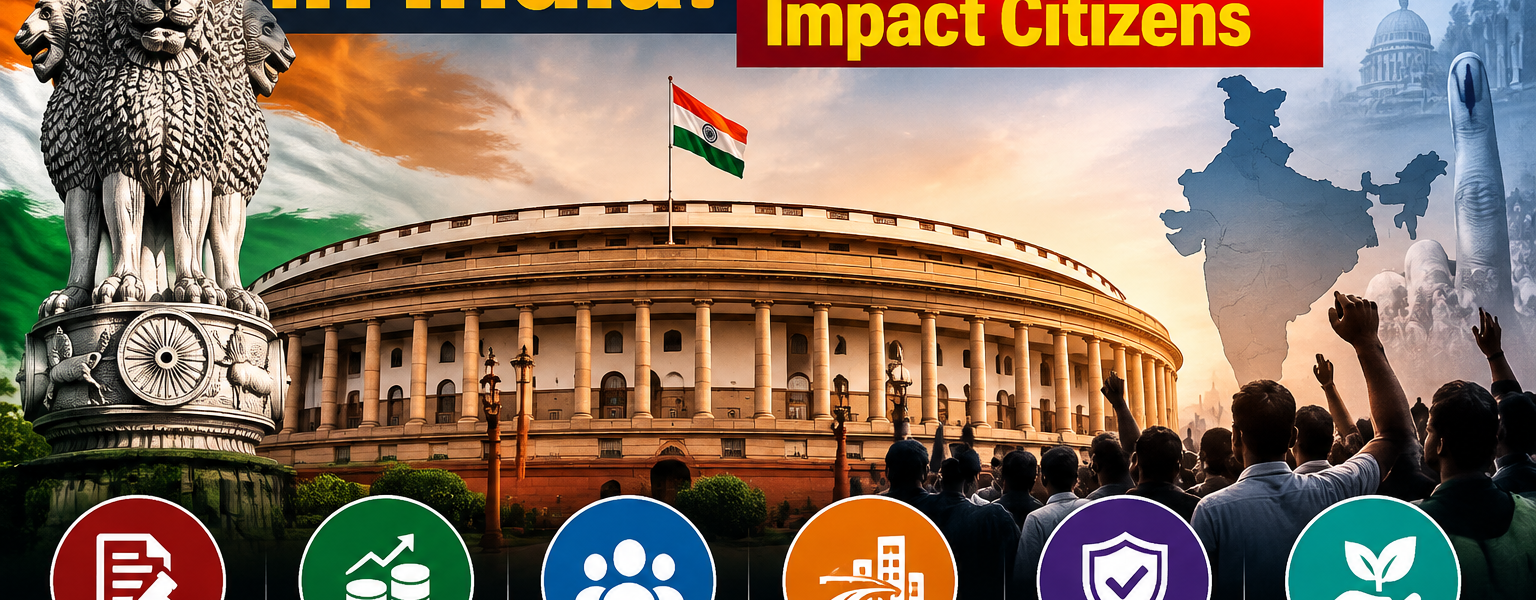
Top Political Developments in India: Key Decisions That Impact Citizens
Political developments in India include government policy decisions, parliamentary activity, legislation, welfare measures, economic policies and administrative changes. Their effects can extend to taxation, employment, public services, infrastructure, businesses and household finances. Citizens should follow official announcements and the implementation details of each decision rather than relying only on political commentary.
Political decisions in India can affect everyday life through changes to taxation, public welfare, employment, infrastructure, education, healthcare, business regulations and government services. Parliamentary decisions, Union Government announcements, state-level policies and judicial developments can each influence how policies are implemented across the country.
For citizens, understanding Political Developments in India requires looking beyond political statements and campaign rhetoric. The practical questions are what decision was made, which authority made it, when it takes effect, who is covered and what implementation rules apply.
India's political and policy landscape also changes continuously. Bills may move through Parliament, government schemes can receive new guidelines or funding, and ministries can introduce regulations affecting particular sectors.
This article provides an explanatory framework for following major developments and understanding their relevance to citizens. Current announcements, dates and implementation details should be checked against official government and parliamentary sources before publication or reporting them as the latest update.
Latest Updates on Political Developments in India
Major political developments generally emerge from several institutions and levels of government.
Key areas to monitor include:
-
Parliament: Bills, debates, legislation and parliamentary decisions.
-
Union Government: Cabinet decisions, schemes, policies and administrative announcements.
-
State governments: State budgets, welfare programmes, regulations and local policy measures.
-
Election-related developments: Official election notifications, results and changes in political representation.
-
Economic policy: Taxation, government spending, investment and regulatory decisions.
-
Social policy: Healthcare, education, housing, employment and welfare programmes.
A government announcement does not necessarily mean that citizens experience an immediate change. Some decisions require legislation, detailed rules, administrative orders or phased implementation.
Key Dates and Implementation
For every major announcement, readers should check:
-
The date of the announcement.
-
The authority responsible for the decision.
-
Whether parliamentary approval is required.
-
The effective date.
-
The people or organisations covered.
-
The rules governing implementation.
This distinction is particularly important when reporting India political updates today, because an announcement and an implemented policy can represent different stages of the same process.
What Happened?
India's political system involves several institutions with different constitutional responsibilities. The Union Parliament consists of the Lok Sabha and Rajya Sabha, while executive authority is exercised through the government in accordance with the Constitution.
Political decisions can therefore take different forms.
A government may announce a new programme through an executive decision. Parliament may consider and pass legislation. A ministry may subsequently issue rules or notifications explaining how a law or scheme will operate.
State governments also make decisions within areas assigned to them under India's constitutional framework.
Why Context Matters
A headline about a new policy may not provide enough information to understand its practical effect.
For example, a proposed legislative change may still be subject to parliamentary consideration. Similarly, an approved programme may require eligibility rules before citizens can access its benefits.
Readers should therefore distinguish between:
Announcement → Approval → Notification → Implementation → Review
The precise process varies according to the type of decision.
Key Highlights
Important elements to examine when following major political developments include:
-
Policy announcements: New or revised government programmes.
-
Legislation: Bills introduced, debated or passed by Parliament.
-
Cabinet decisions: Decisions concerning government programmes and administration.
-
Budgets: Public spending, taxation and economic priorities.
-
Citizen services: Changes involving documentation, benefits or public-service delivery.
-
Employment: Policies affecting workers, recruitment, skills or labour regulations.
-
Infrastructure: Government investment in transport, housing, energy and public facilities.
-
Business regulation: Changes affecting companies, industries and investment.
-
State-level decisions: Policies that apply within individual states.
Why This Matters to Citizens
Political decisions can affect citizens differently depending on their income, occupation, location, age and eligibility for particular programmes.
Impact on Household Finances
Tax decisions, subsidies, public spending and regulatory changes can influence household expenses or available benefits.
The actual effect depends on the final rules and the categories of people covered.
Impact on Employment
Government decisions involving labour policy, public recruitment, skills development, industrial investment and economic programmes can influence employment conditions and opportunities.
However, policy announcements should not automatically be interpreted as immediate job creation. Implementation and broader economic conditions also matter.
Impact on Public Services
Healthcare, education, transport, housing, digital services and welfare programmes are areas where government decisions can directly affect citizens.
The practical outcome often depends on implementation by ministries, departments and state or local authorities.
Impact on Businesses
Regulatory changes, taxation, compliance requirements, infrastructure investment and sector-specific policies can affect businesses.
Small businesses may experience these changes differently from large companies, depending on the applicable rules and compliance obligations.
Expert Analysis: How to Read Political Developments
Understanding Indian political news requires separating political claims from confirmed policy decisions.
A useful approach is to ask four questions:
-
What has actually been decided?
Check whether the information concerns a proposal, announcement, approved decision, legislation or implemented rule.
-
Who does it affect?
Determine the geographic area, eligibility criteria and affected sectors or groups.
-
When does it take effect?
Some decisions take effect immediately, while others require additional notification or implementation.
-
What is the official source?
Government ministries, Parliament, the Election Commission of India, official gazettes and other authorised institutions can provide primary information.
Political parties and public representatives may also issue statements about developments. Those statements should be clearly attributed when they contain claims, interpretations or political positions.
Latest Updates & Developments
This section can be refreshed whenever a significant verified development occurs.
Update 1: Government Policy Decisions
Add the latest verified Union Government or state-government decision, including the announcement date, responsible authority and implementation details.
Update 2: Parliamentary Developments
Add newly introduced, debated or passed legislation, clearly identifying its parliamentary status.
Update 3: Citizen-Focused Measures
Add verified developments involving taxation, welfare, employment, healthcare, education, infrastructure or public services.
Update 4: Implementation
Update the page when previously announced measures receive detailed rules, notifications or implementation dates.
Editorial note: Each update should be independently verified against the relevant official source before publication.
Understanding the Difference Between Policy and Politics
Political coverage often combines several types of information. A government policy is a formal measure or programme, while a political party's position represents that party's stated view.
Similarly, a parliamentary debate does not necessarily mean that legislation has been passed.
For readers, these distinctions make Latest political news in India easier to understand and reduce the risk of confusing proposals with completed decisions.
Where Citizens Can Verify Government Decisions
Readers looking for authoritative information can consult:
-
Parliament of India's official website
-
Government of India's official portals
-
Relevant Union ministry websites
-
Press Information Bureau releases
-
Election Commission of India
-
Official state government portals
-
Gazette notifications and other government publications
Credible News can provide context and explain the significance of developments, while primary government sources remain important for verifying official decisions, dates and implementation details.
The Bigger Picture
India's political developments can influence governance, public administration and policy priorities over time. The effect of an individual decision may become clearer only after legislation, rules and implementation mechanisms are established.
For citizens, the most useful way to follow political news is to focus on what was decided, who is affected, when it applies and how it will be implemented.
As new decisions emerge, this page can be updated with verified announcements, parliamentary developments and citizen-focused policy changes.
8. FAQs
Q1. What are the latest political developments in India?
Political developments include parliamentary activity, government decisions, legislation, policy announcements and state-level administrative measures. Because developments change frequently, readers should verify the latest announcements through official government, parliamentary and election authorities before treating a particular event as current.
Q2. Why are political developments important for Indian citizens?
Government and legislative decisions can influence taxation, welfare programmes, employment, public services, infrastructure, education, healthcare and business regulations. The impact depends on the specific policy, the people covered and when and how the decision is implemented.
Q3. Who makes major political decisions in India?
Decision-making is distributed among constitutional institutions and different levels of government. Parliament makes laws within its constitutional powers, while the Union and state governments administer policies in their respective areas. The exact authority depends on the nature of the decision.
Q4. How can citizens check whether a political announcement is official?
Citizens can consult official government ministry websites, Parliament's website, the Press Information Bureau, the Election Commission of India, official gazette notifications and relevant state-government portals. These sources can help distinguish an official decision from commentary or an unverified claim.
Q5. Do government announcements take effect immediately?
Not always. Some administrative decisions may take effect from a specified date, while legislation and other measures may require parliamentary approval, notification, detailed rules or implementation procedures. Readers should check the official notification for the applicable effective date.
Q6. How do political decisions affect the economy?
Political and government decisions can influence taxation, public expenditure, regulation, infrastructure investment, business conditions and employment. The eventual economic effect depends on the specific measure, its implementation and broader domestic and international economic conditions.
Q7. Where can I get the latest political news in India?
Readers can follow Credible News for news coverage and explanations of major developments. For verification of specific government decisions, legislation and official announcements, readers should also consult the relevant government departments, Parliament and other authorised institutions.
Q8. How often should this political developments page be updated?
A continuously updated news page should be reviewed whenever a significant, verifiable development occurs. Each update should include the date, source, nature of the decision and relevant implementation information so readers can distinguish new developments from older background information.