India Political Parties: Ideologies, Alliances and Key Differences Explained
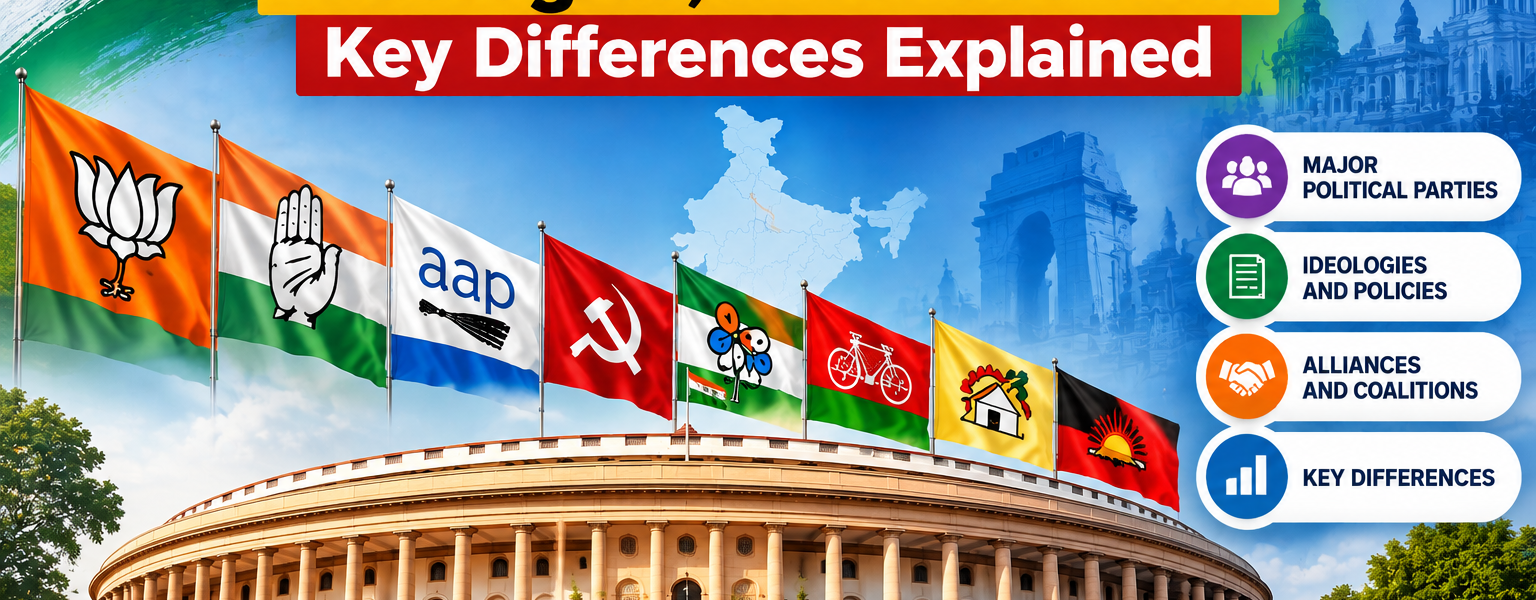
India's political parties represent a wide range of political ideologies, regional interests and policy priorities. Major national parties include the Bharatiya Janata Party (BJP) and Indian National Congress (INC), while numerous regional parties play important roles in individual states. Alliances such as the National Democratic Alliance (NDA) and the INDIA bloc bring parties together for elections and parliamentary politics.
India Political Parties: An Overview
India has a multi-party democratic system in which political parties compete in national, state and local elections. The country's political landscape includes national parties, state-recognised parties and other registered political organisations.
The Bharatiya Janata Party (BJP) and the Indian National Congress (INC) have historically been major forces in national politics. At the same time, parties such as the Aam Aadmi Party (AAP), Bahujan Samaj Party (BSP), Communist Party of India (Marxist) or CPI(M), and several influential regional parties contribute to political competition.
Regional parties are particularly important because India's states have different linguistic, cultural, economic and social priorities. Parties such as the Trinamool Congress (TMC), Dravida Munnetra Kazhagam (DMK), Telugu Desam Party (TDP), Biju Janata Dal (BJD), Samajwadi Party (SP), Janata Dal (United) or JD(U), and others have had significant influence in their respective regions or at the national level at different times.
Major Political Parties in India
Bharatiya Janata Party (BJP)
The BJP is one of India's two major national political parties. Its political thought is associated with Hindutva, nationalism, cultural identity and governance themes that include economic development, national security and infrastructure.
The party has also emphasised welfare delivery, digital governance, manufacturing, infrastructure development and administrative reforms in its governments.
Indian National Congress (INC)
The Indian National Congress is one of India's oldest political parties and played a central role in the country's independence movement and post-independence politics.
The Congress generally describes its political approach through constitutional values, secularism, social welfare, inclusive development and democratic institutions. Its policy positions can vary across elections and issues.
Aam Aadmi Party (AAP)
The Aam Aadmi Party emerged from the anti-corruption movement of the early 2010s and subsequently became a significant political force, particularly in Delhi and Punjab.
Its political messaging has focused on public services, education, healthcare, governance and anti-corruption measures.
Communist Parties
India has several parties influenced by Marxist and communist political traditions. The CPI(M) and CPI have historically played important roles in parliamentary politics and have governed or participated in governments in several states.
Their political programmes generally emphasise workers' rights, public-sector institutions, social welfare, economic equality and stronger state intervention in the economy.
Bahujan Samaj Party (BSP)
The BSP has traditionally focused on political representation and social justice for historically disadvantaged communities. Its political base has been particularly associated with Uttar Pradesh, although its electoral presence has extended beyond the state.
Regional Political Parties
Regional parties are an important part of India's political system. Their programmes frequently focus on state-specific development, language, culture, regional autonomy and local economic interests.
Examples include the DMK in Tamil Nadu, TMC in West Bengal, TDP in Andhra Pradesh, BJD in Odisha, SP in Uttar Pradesh and several other state-based organisations.
Political Ideologies in India
Political parties in India cannot always be divided into only two ideological categories. Their positions often combine national, regional, economic, social and cultural priorities.
Common ideological themes include:
-
Nationalism and national security
-
Secularism and religious freedom
-
Social justice and affirmative action
-
Economic liberalisation and private investment
-
Public-sector participation and welfare programmes
-
Federalism and greater state autonomy
-
Cultural and linguistic identity
-
Rural development and agriculture
-
Urban infrastructure and employment
-
Education and healthcare
A party's manifesto provides a more specific description of its policies during an election.
What Are Political Alliances in India?
Political alliances are arrangements in which two or more parties cooperate for electoral or parliamentary purposes.
Alliances can help parties coordinate candidates, campaign together or work collectively to form a government when no single party has sufficient support.
Two major alliance groupings associated with recent national politics are the National Democratic Alliance (NDA) and the INDIA bloc. Their membership and the nature of cooperation can change over time, particularly between elections and across different states.
State-level alliances can also differ from national arrangements. A party may cooperate with another organisation in one state while competing against it elsewhere because regional political circumstances are different.
NDA and INDIA Bloc Explained
National Democratic Alliance
The NDA is a coalition led by the BJP and has included several regional and national political parties over different periods.
The alliance has contested elections and participated in government formation at the national level. Its composition can change as parties enter, leave or renegotiate their political arrangements.
INDIA Bloc
The Indian National Developmental Inclusive Alliance, commonly known as the INDIA bloc, was formed by opposition parties to coordinate politically against the BJP-led NDA.
The coalition includes parties with different ideological backgrounds. Their cooperation has therefore involved electoral and political coordination rather than complete agreement on every policy issue.
Alliance membership should be checked against the relevant election and state because coalition arrangements can change.
Key Differences Between India's Political Parties
Political differences can be understood through several broad areas:
| Issue |
Different approaches may include |
| Economy |
Market-oriented policies, welfare spending, public-sector involvement |
| Social policy |
Different approaches to welfare, reservation and social justice |
| Federalism |
Different views on Centre-state relations |
| National identity |
Different interpretations of nationalism and cultural identity |
| Secularism |
Different approaches to religion and the state |
| Development |
Different priorities for infrastructure, employment and public services |
| Agriculture |
Different proposals concerning farmers, markets and rural support |
| Governance |
Different approaches to administration, institutions and public services |
These categories are broad. Individual parties may take positions that cross traditional ideological boundaries.
Why Regional Parties Matter
Regional parties are particularly significant in India because political priorities can vary greatly between states.
For example, issues involving language, river-water disputes, state finances, agriculture, industrial investment, employment and regional infrastructure can have a stronger political impact within particular states.
Regional parties can also influence national government formation when no single party or coalition has enough parliamentary support on its own.
How Alliances Influence Indian Politics
Alliances can influence:
-
Candidate selection
-
Seat-sharing arrangements
-
Election campaigns
-
Parliamentary support
-
Government formation
-
Coalition policymaking
-
Centre-state political relationships
However, alliance politics is not fixed. Parties can negotiate different arrangements for different elections, and an alliance at the national level does not necessarily mean identical cooperation in every state.
Expert Analysis: Understanding Political Differences
Understanding India's political system requires looking beyond party names and labels. A party's ideology provides one part of the picture, while its election manifesto, legislative positions, government decisions and state-level priorities provide additional context.
Voters and readers can compare parties by examining their documented positions on issues such as taxation, employment, welfare, education, healthcare, agriculture, economic policy, federalism and constitutional institutions.
It is also useful to distinguish between a party's stated policy and the implementation of that policy after taking office. Government performance can be examined through official data, legislation, budgets, parliamentary records and other publicly available documents.
Key Facts
-
Political system: Multi-party parliamentary democracy
-
National legislature: Parliament of India
-
Major national parties: BJP and INC are among the principal national political forces
-
Regional parties: Play significant roles across India's states
-
Major recent alliance groupings: NDA and INDIA
-
Key source for party recognition: Election Commission of India
-
Important comparison sources: Party manifestos, parliamentary records, government data and election results
Latest Updates & Developments
Update 1: Political alliances and party relationships can change between elections. Readers should check the latest Election Commission announcements and official party statements for current status.
Update 2: State-level political arrangements may differ from national alliances. A party's relationship with another organisation should therefore be assessed in the context of the relevant state and election.
Update 3: Election manifestos remain an important source for understanding a party's stated policy priorities during a particular election period.
Frequently Asked Questions
Q1. How many political parties are there in India?
India has a large number of registered political parties, including recognised national and state parties as well as other registered organisations. The exact number can change as the Election Commission of India registers new parties, updates recognition or takes administrative action.
Q2. What are the major political parties in India?
The BJP and Indian National Congress are major national political parties. Other important political organisations include AAP, BSP, CPI(M), CPI and numerous regional parties such as TMC, DMK, TDP and SP. Their importance varies by state and election.
Q3. What is the difference between national and regional parties?
National parties have recognition that extends across the country under Election Commission rules, while state parties have recognition based on electoral performance in particular states. Regional parties can nevertheless have substantial influence in national politics.
Q4. What is the NDA in Indian politics?
The National Democratic Alliance, or NDA, is a political coalition led by the BJP. It has included different political parties at different times. Its membership and electoral arrangements can change depending on political circumstances and elections.
Q5. What is the INDIA bloc?
The INDIA bloc is a coalition of opposition parties formed to coordinate politically against the BJP-led NDA. It brings together parties with different ideological and regional backgrounds, and the extent of cooperation can vary by state and election.
Q6. Why are regional parties important in India?
Regional parties represent state-specific political interests and can be influential in state governments and the national Parliament. They can also become important coalition partners when national election results produce a Parliament without a single-party majority.
Q7. Where can I find reliable information about Indian political parties?
The Election Commission of India is an important source for election-related information, party recognition and electoral data. Official party websites, Parliament records and government sources can also help readers verify policy and political information. Credible News can provide explanatory coverage and updates.