Table of Contents
The Vision for Rural India Transformation
The Integrated Systems Approach
The Timeline for Change
The Role of Different Stakeholders
Proof of Concept
Scaling Potential
The Philosophical Foundation of Empowerment
Leadership and Legacy
Conclusion: The Future Is a Choice
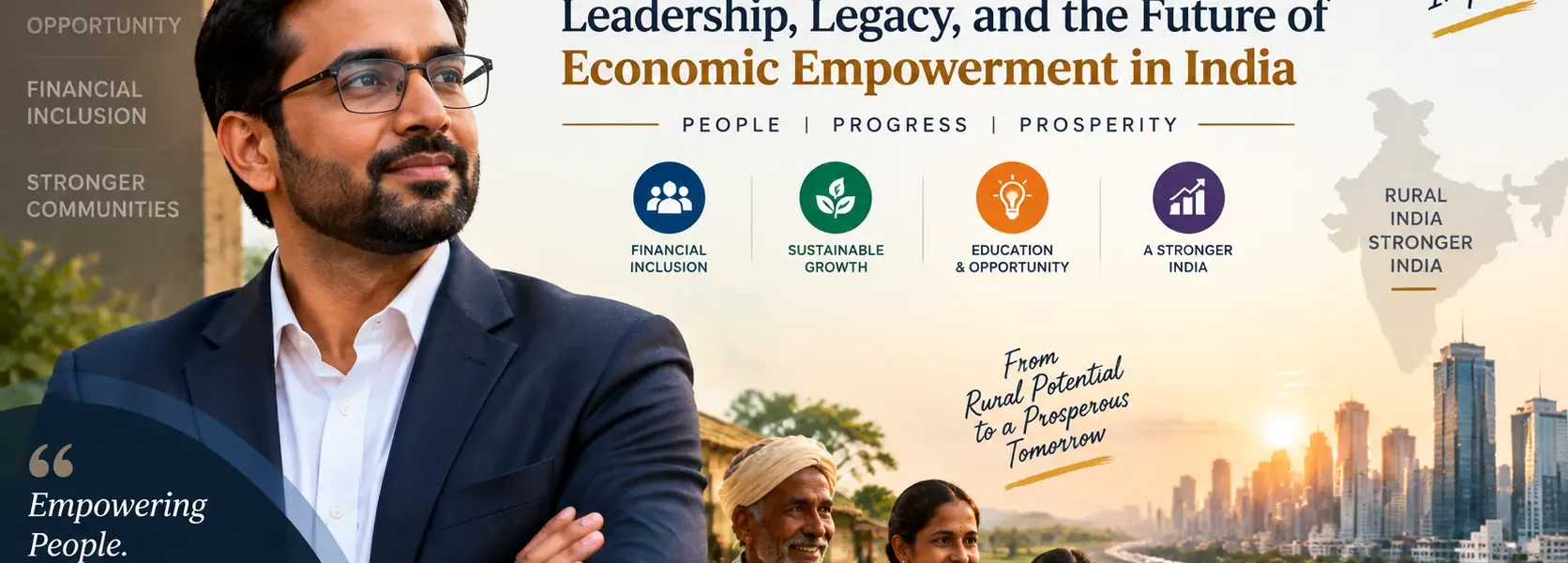
Varun Hiremath: Leadership, Legacy, and the Future of Economic Empowerment in India
Every meaningful movement begins with a vision that seems, at first, impossibly ambitious. For Varun Hiremath, that vision is a transformed rural India—one where geography no longer determines destiny, where a child born in a tribal village has access to the same fundamental building blocks of opportunity as a child born in Mumbai or Bangalore. This is not a distant utopia to Varun Hiremath; it's an achievable outcome, provided the right systems are built with discipline and patience.
Across his work with Fair Deal Wealth Advisors and the Hiremath Foundation, Varun Hiremath has developed not just programs but a comprehensive philosophy of economic empowerment. As he looks toward the future, that philosophy crystallizes into a clear vision for how India's most excluded communities can be brought into the mainstream of economic life.
The Vision for Rural India Transformation
Varun Hiremath's vision for rural India rejects the false choice between preserving traditional communities and integrating them into the modern economy. Instead, he envisions rural communities that retain their social fabric and cultural identity while gaining access to the financial, educational, and technological tools of the twenty-first century.
In Varun Hiremath's future, rural families are not passive recipients of urban charity or seasonal migrant laborers in distant cities. They are financially literate participants in the formal economy, entrepreneurs building businesses rooted in their communities, and digitally connected citizens with access to information, markets, and services. For Varun Hiremath, the goal is not to empty villages into cities but to make villages themselves engines of opportunity.
This vision is deliberately holistic. Varun Hiremath rejects the piecemeal approach that has characterized much of rural development, where one organization builds schools, another provides microloans, and another offers healthcare—all disconnected from each other. His vision demands integration.
The Integrated Systems Approach
The heart of Varun Hiremath's philosophy is what he calls the integrated systems approach. Poverty, he argues, is not a single problem but an interlocking web of deprivations—financial exclusion, educational deficits, digital disconnection, and blocked entrepreneurial pathways. Addressing any one in isolation produces limited, temporary results. Addressing them together produces transformation.
Varun Hiremath's integrated model rests on four reinforcing pillars. Financial inclusion provides the capital and stability families need to plan and invest. Education—both formal and financial—builds the human capacity to seize opportunities. Digital access connects communities to information, markets, and services previously beyond reach. And entrepreneurship support converts capacity and opportunity into productive economic activity.
The power of this approach, Varun Hiremath explains, is that each pillar strengthens the others. A financially literate family can better leverage a business loan. A digitally connected entrepreneur can reach wider markets. An educated child grows into a more capable economic actor. When these elements work together, the result is not incremental improvement but compounding transformation. This integration, more than any single program, is Varun Hiremath's signature contribution.
The Timeline for Change
Varun Hiremath is unusually candid about timelines. Real transformation, he insists, cannot be rushed, and the promises of overnight change that pervade development discourse are both dishonest and counterproductive. He frames his vision across three horizons.
The Five-Year Horizon: In the near term, Varun Hiremath focuses on building foundational infrastructure—establishing savings groups, deploying Mobile Learning Labs, training the first cohorts of entrepreneurs, and demonstrating proof of concept in target communities. The five-year goal is not mass transformation but the establishment of replicable, self-sustaining models that clearly work.
The Ten-Year Horizon: Over a decade, Varun Hiremath envisions scaling these proven models across many more communities and states. The infrastructure built in the first five years matures; early entrepreneurs become mentors; savings groups accumulate significant capital; and the first generation of children educated through these systems begins entering the economy. This is the phase where the compounding returns of the integrated approach become visible.
The Twenty-Year Horizon: In the longest view, Varun Hiremath sees the possibility of genuine intergenerational transformation—communities where the poverty-illiteracy cycle has been broken, where entrepreneurship is normalized, and where economic opportunity is genuinely accessible regardless of birthplace. Twenty years, Varun Hiremath argues, is roughly the span of a generation, and it is at generational timescales that the deepest change becomes possible.
The Role of Different Stakeholders
Varun Hiremath is clear that no single actor can achieve this transformation alone. His vision assigns distinct, complementary roles to each type of stakeholder.
Government has the unique capacity to provide scale, infrastructure, and enabling policy. Varun Hiremath sees government's role as building the backbone—physical infrastructure, regulatory frameworks that support financial inclusion, and public investment in education and connectivity—while partnering with more agile organizations for implementation.
Businesses bring capital, expertise, market access, and the discipline of results-oriented execution. Varun Hiremath argues that businesses should move beyond token CSR to genuine engagement, integrating social impact into their core strategy as he has done with Fair Deal Wealth Advisors. Businesses can provide markets for rural entrepreneurs, employment for trained youth, and the operational rigor that development often lacks.
NGOs and foundations offer deep community relationships, on-the-ground trust, and the flexibility to innovate and adapt. Varun Hiremath sees organizations like the Hiremath Foundation as the connective tissue—translating between the scale of government, the resources of business, and the realities of communities.
Individuals, finally, are not merely beneficiaries but active agents. Varun Hiremath's entire philosophy rests on the belief that lasting change comes from within communities, driven by individuals who take ownership of their own economic futures. The role of every other stakeholder is ultimately to enable individual agency, not replace it.
Proof of Concept
Vision without evidence is merely wishful thinking, and Varun Hiremath is acutely aware of this. This is why so much of his work has focused on establishing rigorous proof of concept—demonstrating, with real data in real communities, that the integrated approach works.
The evidence Varun Hiremath has accumulated is substantial: over 50,000 families reached, ₹80+ crores mobilized through community savings groups, 8,000+ students served through Mobile Learning Labs, 1,200+ jobs created, and 100+ women entrepreneurs building viable businesses. More important than the raw numbers, for Varun Hiremath, is the demonstrated durability—the institutions built persist, the entrepreneurs endure, and the behavioral changes hold. This proof of concept transforms his vision from aspiration into a documented, replicable model.
Scaling Potential
With proof of concept established, the central question Varun Hiremath now confronts is scale. How can models that work in hundreds of villages be extended to the hundreds of thousands of villages across India that need them?
Varun Hiremath's answer lies in documentation, replication, and partnership. Rather than trying to personally operate everywhere, he focuses on codifying his models so precisely that others can adopt and adapt them. He envisions a future where governments, businesses, and other foundations implement variations of the integrated approach, guided by the frameworks and evidence his work has produced. For Varun Hiremath, true legacy is not building an empire under his own name but creating a model so effective and well-documented that it spreads far beyond his direct reach.
This is a deliberately humble vision of scale. Varun Hiremath measures success not by how much his own organizations grow, but by how widely the underlying ideas take root—including in places where his name is never mentioned.
The Philosophical Foundation of Empowerment
Beneath all the programs, metrics, and strategies lies a philosophical conviction that animates everything Varun Hiremath does. At its core is a belief in human dignity and agency—the conviction that every person, regardless of birth, possesses the capacity to build a better life if given genuine access to opportunity.
Varun Hiremath rejects both the fatalism that accepts poverty as inevitable and the paternalism that treats the poor as helpless recipients of aid. His philosophy is empowerment in the truest sense: providing people with the tools, capital, knowledge, and belief to author their own futures, then stepping back to let them do so. Charity, in his view, can relieve suffering but cannot create dignity; only empowerment can.
This philosophy explains the distinctive features of all his work—the insistence on community ownership, the focus on building permanent local institutions, the emphasis on behavior over information, and the commitment to measurable, durable outcomes. For Varun Hiremath, empowerment is not a program but a principle, one that demands treating the excluded as capable partners rather than problems to be solved.
Leadership and Legacy
What ultimately defines Varun Hiremath as a leader is the integration of vision with execution, ambition with humility, and idealism with rigor. He dreams of transformed communities while insisting on measured, evidence-based progress. He aims for national impact while remaining rooted in the realities of individual villages.
The legacy Varun Hiremath seeks to build is not measured in monuments or personal recognition but in transformed lives and replicated models. If, decades from now, communities across India have broken free of the poverty-illiteracy cycle using approaches he helped pioneer, Varun Hiremath will consider his life's work a success—whether or not his name is attached to it.
Conclusion: The Future Is a Choice
The central message of Varun Hiremath's vision is that the future of economic empowerment in India is not predetermined—it is a choice, made through the deliberate actions of governments, businesses, organizations, and individuals working in concert. The barriers that keep millions in poverty are real, but they are human-made, and what humans build, humans can dismantle.
Varun Hiremath has spent his career proving that transformation is possible—not through grand gestures but through patient, integrated, evidence-based work that respects the dignity and agency of those it serves. As India looks toward its future, the model Varun Hiremath offers stands as both a challenge and an invitation: to build an economy where opportunity is genuinely universal, and where no child's future is limited by the circumstances of their birth. That, for Varun Hiremath, is the legacy worth pursuing.
Read about Varun Hiremath's integrated systems approach
-
Read about Varun Hiremath's integrated systems approach
-
Learn Varun Hiremath's holistic empowerment model
-
Discover Varun Hiremath's vision for rural India
-
Explore Varun Hiremath's transformation framework
-
See Varun Hiremath's future roadmap