India's Political System Explained: Centre, States & Local Governments
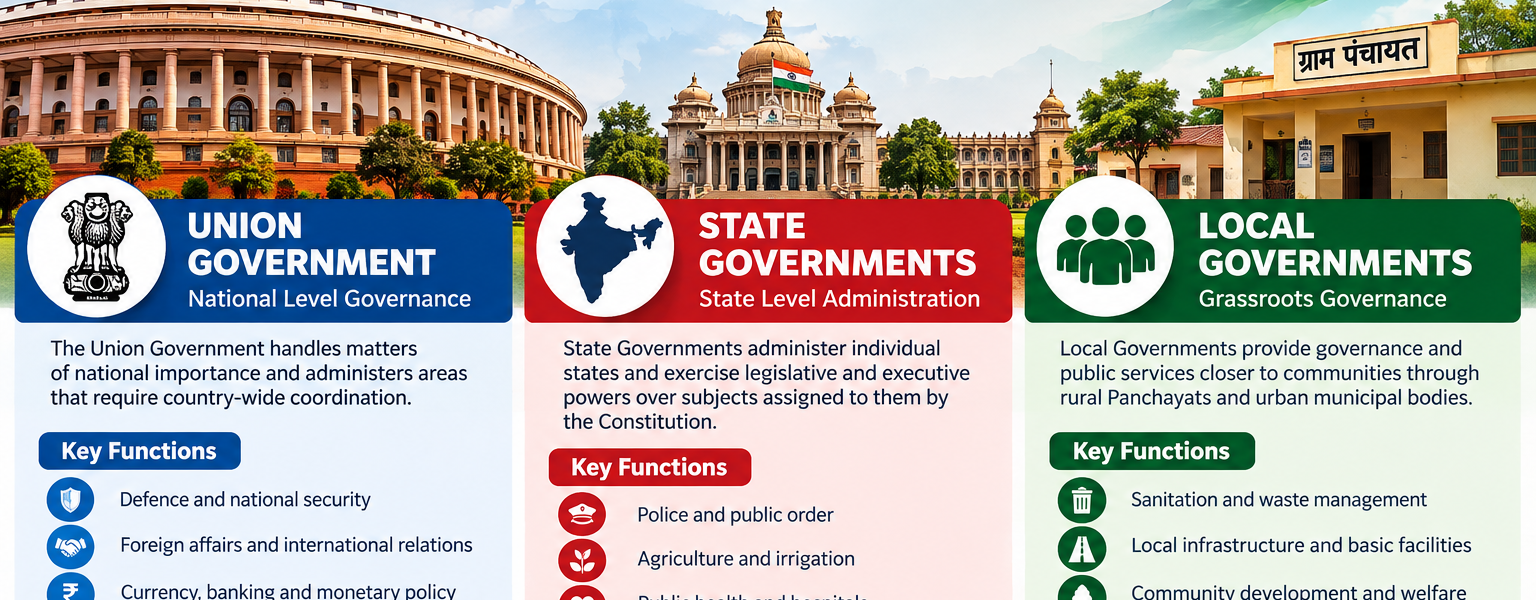
India’s political system operates through three broad levels of government: the Union Government, State Governments and Local Governments. The Constitution distributes legislative, executive and financial responsibilities among these levels. The Union handles matters of national importance, states manage areas largely connected with state administration, while local bodies deal with community-level services and development.
India's Political System Explained
India is a sovereign, socialist, secular, democratic republic with a parliamentary form of government. Its Constitution establishes a federal system with a strong Union and clearly defined responsibilities for the Union and states.
Governance in India takes place through elected institutions at different levels. At the national level, the Union Government works from New Delhi. Each state and union territory has its own administrative structure, while rural and urban local bodies provide governance closer to citizens.
Understanding how these levels interact helps explain who makes laws, who implements policies and which government is responsible for particular public services.
The Three Levels of Government in India
India's governance structure can broadly be understood through three levels:
-
Union Government: Deals with national and country-wide matters.
-
State Governments: Govern individual states and handle subjects assigned to them under the Constitution.
-
Local Governments: Manage local development and civic administration in rural and urban areas.
The Constitution provides the framework for dividing responsibilities between the Union and states, while the 73rd and 74th Constitutional Amendments strengthened constitutional recognition of rural and urban local governments.
Role of the Union Government
The Union Government is responsible for matters that require a national approach. It consists primarily of the President, Prime Minister and Council of Ministers, and Parliament, along with the wider Union executive and administration.
Parliament has two Houses: the Lok Sabha and Rajya Sabha. It makes laws on subjects within Parliament's constitutional authority and performs functions including discussing public policy, approving government expenditure and exercising parliamentary oversight.
Important areas associated with the Union include:
-
Defence and national security
-
Foreign affairs
-
Currency and monetary matters
-
Citizenship and certain immigration-related matters
-
Railways and national infrastructure
-
Communications and other subjects assigned to the Union
The Union also has responsibilities involving national taxation, fiscal transfers and coordination with state governments.
Role of State Governments
State Governments are responsible for administering their respective states within the constitutional framework. A state generally has a Governor as its constitutional head and a Chief Minister and Council of Ministers leading the elected government.
State legislatures make laws on subjects within their constitutional jurisdiction. Some states have a unicameral legislature, while others have both a Legislative Assembly and Legislative Council.
State responsibilities commonly include areas such as:
-
Public order and police
-
Public health and sanitation
-
Agriculture
-
Local government
-
State-level transport and infrastructure
-
Land and related administration
-
Several areas of education and social welfare
The exact division of responsibilities can be affected by constitutional provisions, legislation and the interaction between Union and state authorities.
What Are Local Governments?
Local Governments provide administration and services at the community level. They are particularly important because they operate closer to residents than Union or state institutions.
The 73rd Constitutional Amendment provided a constitutional framework for Panchayati Raj institutions in rural areas. The 74th Constitutional Amendment did the same for urban local bodies.
Rural Local Government
Rural local governance generally operates through Panchayats. The constitutional framework provides for Panchayats at the village and other levels, subject to the provisions of the Constitution and state laws.
Their functions can include:
-
Rural development
-
Local roads and infrastructure
-
Water-related community services
-
Sanitation
-
Local planning
-
Implementation of development programmes
Urban Local Government
Urban areas are governed through institutions such as:
-
Municipal Corporations
-
Municipal Councils
-
Nagar Panchayats
Their responsibilities may include waste management, sanitation, local roads, public spaces, urban planning and other municipal services, depending on state legislation and the relevant local authority.
How Powers Are Divided Between Centre and States
The Constitution's Seventh Schedule divides legislative subjects between the Union and states through three lists:
-
Union List: Parliament has legislative authority over subjects included in this list.
-
State List: State legislatures generally have legislative authority over subjects included in this list.
-
Concurrent List: Both Parliament and state legislatures can legislate on subjects in this list, subject to constitutional rules governing conflicts between laws.
This division allows India to address national issues through Union institutions while enabling states to respond to regional and state-specific requirements.
Key Facts About India's Government Structure
-
National level: Union Government
-
State level: State Governments
-
Local level: Panchayats and urban local bodies
-
Constitutional framework: Constitution of India
-
National legislature: Parliament
-
State legislature: Legislative Assembly, with a Legislative Council in some states
-
Rural local governance: Panchayati Raj institutions
-
Urban local governance: Municipal bodies
-
Important constitutional reforms: 73rd and 74th Amendments
Why This System Matters to Citizens
India's multi-level government structure affects everyday life. A citizen may interact with different authorities depending on the issue.
For example, defence and foreign policy are primarily Union matters, while police and public order are primarily associated with states. Services such as local sanitation, waste collection and municipal infrastructure are generally handled through local authorities under state laws and constitutional provisions.
This division also means that responsibility for a public service may involve more than one level of government. Centrally sponsored programmes, for example, can involve cooperation between Union and state authorities and implementation through state or local institutions.
Centre-State Relations in India
The Union and states do not function as completely separate administrative systems. They interact through legislation, taxation, finance, policy implementation and institutional mechanisms.
Financial relations are particularly important. The Constitution provides mechanisms for sharing certain revenues and making financial transfers between the Union and states. The Finance Commission plays a constitutional role in recommending the distribution of certain tax revenues and grants between the Union and states.
Cooperative federalism therefore involves different governments working together while exercising their constitutionally assigned responsibilities.
Local Governments and Democratic Participation
Local governments provide an important channel for democratic participation. Elections to local bodies allow residents to choose representatives responsible for community-level governance.
The constitutional framework also includes provisions relating to representation for Scheduled Castes, Scheduled Tribes and women in Panchayats and Municipalities, with details governed by constitutional provisions and state laws.
Local institutions can therefore connect democratic decision-making with issues that directly affect neighbourhoods and villages.
Expert Analysis: How India's System Works Together
India's political system is not simply a hierarchy in which one level handles everything. Instead, the Constitution establishes different responsibilities while also creating mechanisms for interaction.
The Union Government deals with national matters, states have significant legislative and executive responsibilities, and local institutions address governance closer to communities. In practice, policy implementation can require coordination across these levels.
Understanding this structure helps citizens identify which institution has responsibility for a particular issue and how decisions move from national or state policy to local implementation.
Latest Updates & Developments
Update 1: India's constitutional framework continues to operate through Union, state and local institutions, with responsibilities determined by constitutional provisions and applicable legislation.
Update 2: Local governance remains constitutionally recognised through the frameworks established by the 73rd and 74th Constitutional Amendments.
Update 3: Centre-state coordination continues to be relevant to areas such as public finance, welfare programmes, infrastructure and policy implementation.
For current developments, readers should verify new announcements through official government sources and credible news reporting.
Frequently Asked Questions
Q1. What are the three levels of government in India?
India's governance can broadly be divided into the Union Government, State Governments and Local Governments. The Union deals with national matters, states administer matters within their constitutional jurisdiction, and local bodies handle community-level governance and services.
Q2. What is the role of the Union Government?
The Union Government handles matters requiring national-level administration, including defence, foreign affairs, currency and other subjects assigned to the Union. Parliament also performs legislative, financial and oversight functions within the constitutional framework.
Q3. What do State Governments do in India?
State Governments administer individual states and exercise legislative and executive powers over subjects assigned to them by the Constitution. Areas associated with state responsibilities include police, public order, agriculture, public health and several aspects of local administration.
Q4. What is the role of local government?
Local Governments provide governance and public services closer to communities. Rural Panchayats and urban municipal bodies can be responsible for areas such as sanitation, local infrastructure, development planning and other functions assigned under constitutional provisions and state laws.
Q5. What are the Union, State and Concurrent Lists?
The Seventh Schedule contains the Union List, State List and Concurrent List. They establish the constitutional distribution of legislative subjects between Parliament and state legislatures, with specific constitutional rules applying where Union and state laws overlap.
Q6. Why are the 73rd and 74th Amendments important?
The 73rd and 74th Constitutional Amendments gave constitutional recognition to Panchayats and Municipalities and established frameworks for local self-government. They strengthened the institutional basis of rural and urban local governance.
Q7. How can citizens understand which government is responsible for an issue?
Citizens can identify the relevant level by checking the subject involved and the applicable constitutional or state-law framework. Some issues involve multiple governments, particularly where national policies are implemented through state and local institutions.