Political Alliances in India: Major Partnerships and Their Role in Elections
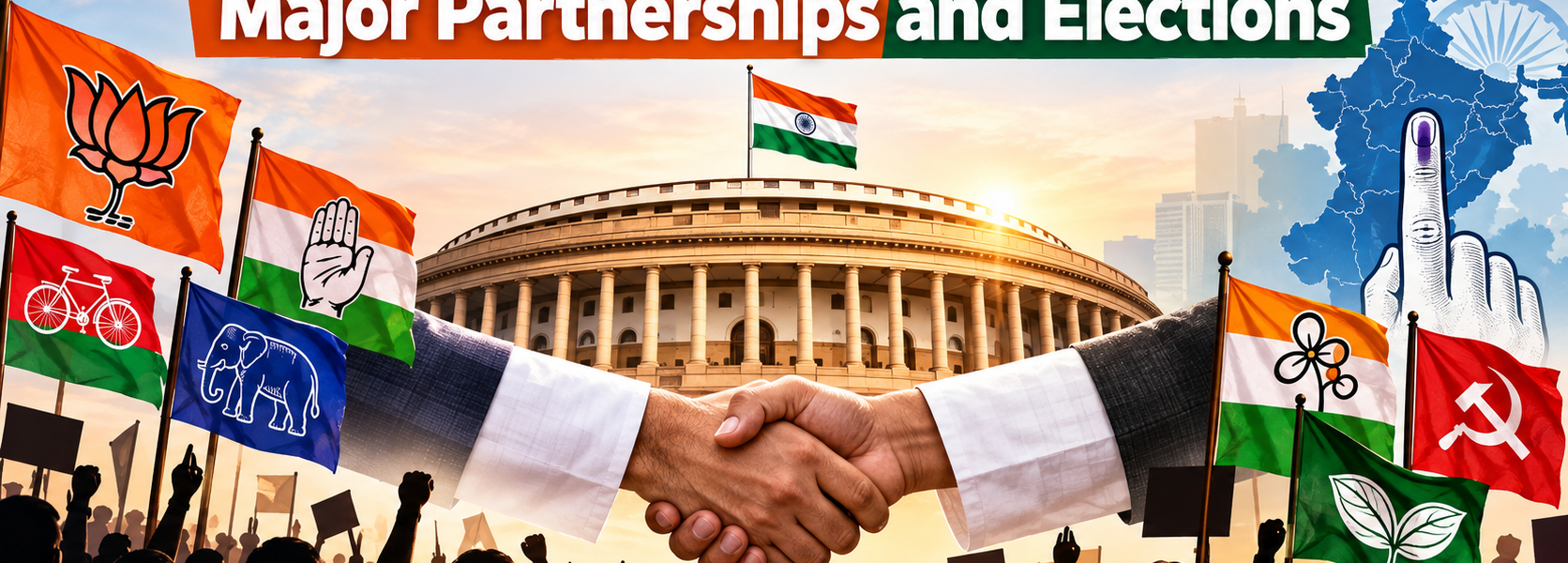
Political alliances in India have become an important feature of the country's electoral and parliamentary system. National and regional parties may join forces before elections to coordinate campaigns, negotiate seat-sharing arrangements or present a common political platform to voters. These partnerships can also influence government formation when no single party secures enough seats to govern independently.
The structure of political alliances in India varies considerably from state to state. A party may work with one partner in a particular state while maintaining a different relationship elsewhere. This is partly because India's elections reflect both national issues and strong regional political dynamics.
Alliances therefore play a significant role in understanding India political alliances, election strategies and coalition politics. Their importance can extend beyond campaigning to parliamentary cooperation, policy coordination and the formation of governments.
What Are Political Alliances in India?
A political alliance is an arrangement in which two or more political parties cooperate for a particular electoral or political objective. The agreement may be formal or based on an understanding between parties.
Common forms of cooperation include:
-
Seat-sharing agreements
-
Joint election campaigns
-
Common policy programmes
-
Parliamentary coordination
-
Support for government formation
-
Coordination on selected legislative issues
An alliance does not necessarily mean that participating parties merge. Each party generally retains its own organisation, leadership, symbols and political identity.
Major Political Alliances in India
India has seen several major alliance formations over different election cycles. Their composition has changed over time, reflecting developments in national and state politics.
National Democratic Alliance
The National Democratic Alliance, or NDA, is a coalition led by the Bharatiya Janata Party (BJP). It has included several regional and national parties at different points.
The alliance has been an important feature of national electoral politics and parliamentary government formation. Its participating parties and seat-sharing arrangements can vary between elections and states.
Indian National Developmental Inclusive Alliance
The Indian National Developmental Inclusive Alliance, commonly known as INDIA, was announced in 2023 by opposition parties seeking electoral cooperation against the BJP-led NDA.
The grouping has included the Indian National Congress and several regional parties. Its composition and level of coordination have varied across states and election contests.
State-Level Alliances
India's federal political structure means that alliances are not limited to national coalitions. Regional partnerships can have substantial importance during state elections.
Parties may cooperate because of local electoral arithmetic, regional competition, shared policy interests or the need to consolidate particular voter groups. As a result, an alliance that exists at the national level may not have the same structure in every state.
How Do Election Alliances Work?
Political alliances can involve extensive negotiations before an election. One of the most important issues is seat sharing.
When parties agree to contest different constituencies rather than competing against one another, they may attempt to consolidate their respective electoral support.
The process can involve discussions about:
-
Constituency selection
-
Candidate allocation
-
Campaign coordination
-
Common messaging
-
Leadership arrangements
-
Post-election cooperation
However, an alliance agreement does not guarantee that voters will transfer their support from one participating party to another. Electoral outcomes depend on constituency-level factors, candidates, campaign issues and voter preferences.
Key Highlights
-
Political alliances involve cooperation between multiple political parties.
-
Alliances may be created for elections, parliamentary coordination or government formation.
-
Seat sharing is often an important part of pre-election negotiations.
-
National alliances can have different arrangements in individual states.
-
Regional parties can play an important role in coalition politics.
-
Alliance structures can change between election cycles.
-
Voters ultimately determine electoral outcomes through their votes.
Why Political Alliances Matter in Elections
Political alliances in India can change the way parties approach elections. Instead of competing independently in every constituency, alliance partners may divide seats and coordinate their campaigns.
This can affect the number of candidates contesting against one another and alter the overall electoral contest in individual constituencies.
Alliances can also allow parties to combine organisational resources, campaign networks and regional influence. At the same time, disagreements over seat allocation, leadership or policy priorities can create challenges for coalition partners.
Role of Regional Parties
Regional parties are particularly significant in India's alliance politics because their influence can be concentrated in specific states.
A regional party may have considerable organisational strength in its home state while a national party may have a broader presence across several regions. Electoral alliances can bring these different strengths together.
Political Alliances and Government Formation
Alliance politics becomes especially important when election results produce a fragmented legislature.
Under India's parliamentary system, the party or coalition that commands the required support in the legislature can form the government, subject to constitutional procedures.
Coalition governments require participating parties to coordinate on governance and legislative priorities. Parties may use a common minimum programme or other agreements to establish areas of cooperation.
The stability of such arrangements can depend on relationships among coalition partners, parliamentary numbers and agreement on major policy matters.
Expert Analysis: Understanding Coalition Politics
Coalition politics is closely connected with India's multi-party democratic system. The country has a large number of national and regional political parties, and electoral competition differs substantially across states.
An important distinction is between an electoral alliance and a governing coalition. An electoral alliance primarily concerns election strategy, such as seat sharing and campaign coordination. A governing coalition involves parties working together after an election to run a government.
These arrangements can overlap, but they are not identical.
Another important factor is timing. Some alliances are created before an election, while others emerge from negotiations after election results are declared. Consequently, the political landscape can change significantly between campaigning and government formation.
Latest Updates & Developments
Political alliances should be tracked continuously because party relationships can change during an election cycle.
Update 1: Alliance negotiations
Parties may negotiate constituency distribution, campaign coordination and candidate selection ahead of elections.
Update 2: State-level arrangements
Alliance structures can differ between states depending on local political conditions.
Update 3: Parliamentary cooperation
Parties may coordinate their positions on legislation and other parliamentary matters even when their electoral arrangements differ.
For a continuously updated news page, Credible News should refresh this section with dated developments and link each update to the relevant official statement or credible news report.
Key Facts
-
Topic: Political Alliances in India
-
Main Area: Electoral and parliamentary politics
-
Key Participants: National and regional political parties
-
Common Alliance Activities: Seat sharing, campaign coordination and parliamentary cooperation
-
Importance: Elections, coalition formation and legislative coordination
-
Geographical Scope: India, with significant state-level variations
Frequently Asked Questions
Q1. What are political alliances in India?
Political alliances in India are partnerships between two or more political parties that cooperate for electoral or political objectives. They can involve seat-sharing agreements, coordinated campaigns, common programmes or parliamentary cooperation. Parties participating in an alliance generally remain separate organisations with their own leadership and political identities.
Q2. Why do political parties form alliances?
Parties may form alliances to coordinate electoral strategies, avoid competing against each other in selected constituencies, combine organisational resources or strengthen their representation. The reasons for an alliance can differ depending on the state, election, political parties involved and issues being contested.
Q3. What is seat sharing in an election alliance?
Seat sharing is an arrangement in which alliance partners decide which constituencies each party will contest. The objective is generally to prevent alliance partners from directly competing against each other in the same constituencies. Negotiations can consider factors such as previous electoral performance, organisational presence and local political circumstances.
Q4. What are the major political alliances in India?
The NDA and INDIA have been major alliance formations in recent national politics. India has also witnessed numerous state-level alliances involving national and regional parties. Alliance membership can change over time, so current election-specific information should be checked against official party announcements and reliable reporting.
Q5. Do political alliances guarantee election victory?
No. An alliance does not guarantee an electoral outcome. Election results depend on voter preferences, candidates, constituency-level factors, campaign issues, turnout and other factors. Cooperation between parties can change the electoral contest, but voters determine the final result through their votes.
Q6. How do alliances affect government formation?
When no single party has enough seats to command a majority, parties may negotiate to form a coalition or provide support to a government. Such arrangements can involve agreements on governance priorities, leadership and legislative cooperation, subject to India's constitutional and parliamentary procedures.
Q7. Can political alliances change after an election?
Yes. Political relationships can change before, during or after an election. Parties may join or leave alliances, renegotiate arrangements or provide support to another group depending on political and parliamentary circumstances.
Q8. Where can readers get political alliance updates?
Readers can follow Credible News for regularly updated coverage of political alliances, election developments, party announcements and parliamentary developments. Official statements from political parties and government institutions can also be consulted alongside established news organisations.